Breathing All the Way Down
Does your body know the difference between a deep breath and an aggressive breath?
In late February I had the great fortune of attending a Zen training with Norma Wong Roshi. One of the ways Wong Roshi’s Far-Flung Sangha trains is by working intensively with okyo (Zen chanting), and vocal resonance. As you might imagine, several days of training with this group provided many opportunities to observe the ways people organize their bodies and breath to create a full, resonant sound. It was a delight on many levels.
Okyo is a challenging practice for a variety of reasons, one of which is that it is performed at a rapid pace. This means that each inhale must be both quick and deep. Interestingly, the students who have access to an efficient, easeful breath also produce the most resonant sound.
Tension in the breath can be heard. When the body has to muscle the air in, what I call an aggressive breath, the sound tends to get stuck in the upper chest and throat. A body that can take a deep breath, all the way down to the pelvic floor, produces a rounder sound that fills the space from the earth up. This person will also generally require fewer breaths. They chant like a well-oiled kiai machine.
Outside of chanting, and even outside of Zen, research continues to affirm the importance of deep breathing, particularly practices that lengthen the exhale relative to the inhale. Doing so has positive effects on the autonomic nervous system. For Zen practitioners this is a welcome benefit, and perhaps even a vital element of what we might call the physiology of samadhi. But it’s samadhi we’re ultimately after, and our tradition has known the experiential truth of deep breathing for thousands of years.
So how do you do this?
The short answer is that the pelvic floor and diaphragm have to become a team, working together to create the conditions for an optimal breath. As a first step toward this collaboration, it is useful to explore posture; specifically how to align the ribs and diaphragm over the pelvic bowl so that the diaphragm and pelvic floor can move in functional relationship with each other.
Imagine your abdomen is a large water balloon that happens to contain organs. This water balloon has a relatively fixed volume. (Relative is an important word here: a large meal or backed-up digestive tract can limit your ability to breathe.) Now imagine that this water balloon has two trampolines: a concave trampoline at its base (the pelvic floor) and a convex trampoline at its top (the diaphragm).
An ideal breath functions like this:
Inhale: The diaphragm contracts downward, applying pressure to the water balloon. That pressure causes the balloon to bulge slightly and shift downward. This downward movement gently expands the lower trampoline (the pelvic floor). When this happens well, it creates a vacuum in the thoracic cavity, where the lungs live, and air naturally and easily rushes in to fill that space.
Exhale: The diaphragm gradually releases its contraction, rebounding back to its convex shape. This decreases the pressure on the abdomen, and the pelvic floor recollects itself through a gentle contraction. Together these movements help return the abdominal contents to their original position and move air out of the thoracic cavity.
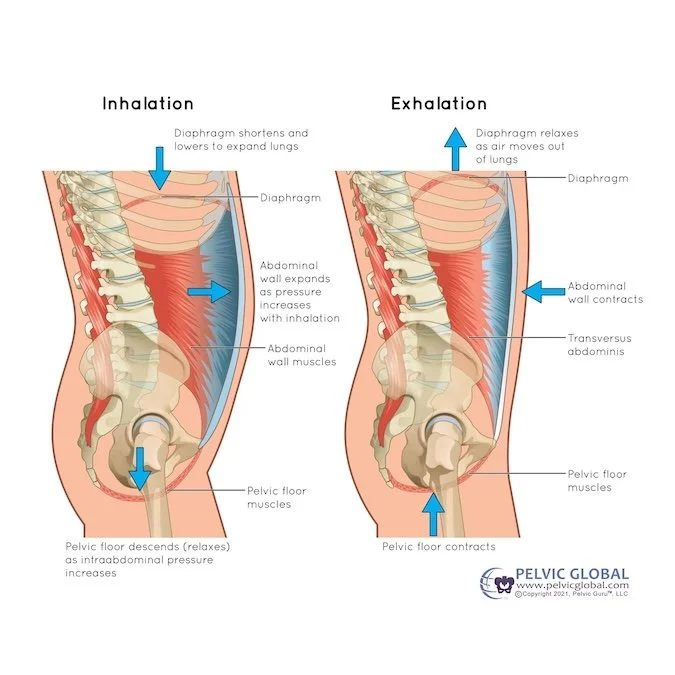
Image credit: © 2021 Pelvic Guru, LLC / Pelvic Global.
For our purposes today, I want to focus on optimizing pelvic floor function rather than exploring posture. I have two main reasons for this: first, the pelvic floor is the missing link for many otherwise functional breathers; second, we already have a number of resources available to help you explore the musculature that connects and aligns the ribcage with the pelvis.
To explore some of that material, you can review my post on Hanna Somatics, Kushner Roshi’s post emphasizing the importance of inhalation, his post on using the PMR technique for breath, his post on Hara & Zazen, or take a deeper dive through our Hara Foundations course.
Now, to the pelvic floor.
First, it may be useful to map the territory. The pelvic floor is a group of muscles that form a hammock-like structure spanning the space between the two sitting bones (ischial tuberosities), and from the pubic bone to the tailbone. The image of a hammock is a common way to describe the anatomy, but I find it doesn’t fully capture the way the pelvic floor moves up and down as the muscles contract and release. For that reason, I prefer to think of it as a concave trampoline.
The following exercises will help you identify your pelvic floor, reacquaint it with your diaphragm, and track the changes that occur in your breath.
To measure the impact of these exercises, we will use sound as our barometer.
Setting the baseline with “ah”
Find a comfortable seat, aligning your pelvis and ribs so that you can breathe with relative ease.
Inhale.
Exhale by chanting the sound “ah” all the way to the natural end of the breath.
Do not force or overexert here. Simply find the natural end of the exhale.
Repeat this 3–5 times and notice:
The quality of the inhale. Does it feel deep? Full? Incomplete? Shallow?
The length of the exhale.
The quality of the sound.
Is it pleasing to the ear or strained?
Where does the pitch naturally land—high or low?
Where did the sound seem to originate in your body?
Was it pushed out by your throat?
Did it arise from your chest?
Did it emanate from your lower abdomen?
From here, let’s explore whether—and how—your pelvic floor participates in your breath. If your pelvic floor is unfamiliar territory, this practice will also help you locate it.
Exercise 1 – Finding your pelvic floor in breath
Sit on a firm, flat surface such as a wooden bench or metal folding chair. Alternatively, come to kneeling with yoga blocks under your pelvis.
Place a thinly rolled washcloth on the surface of your seat. Orient it vertically so that when you sit down your two sitting bones straddle the cloth.
You should feel the roll making contact with the tissues between the pubic bone and tailbone.
Observe how the tissues contacting the cloth change as you inhale and exhale. Do they move?If so, how?
As a reminder, optimal breathing includes a release and expansion of the pelvic floor on the inhale, and a gentle contraction or lift on the exhale. Most people find that either very little movement occurs, or that the movement is reversed.
Exercise 2 – Optimizing pelvic floor rhythm
Return to the set-up from above.
Inhale and bring your awareness to the pelvic floor.
Exhale and gently squeeze the space between your sitting bones. Work subtly.
This is a horizontal narrowing.
Imagine that an unfolded tissue is lying underneath you.
Now imagine picking up that tissue using only your pelvic floor muscles.
Inhale and allow the pelvic floor to release.
Feel for a widening between the sitting bones.
Let the tissue spread back out.
Repeat 3–5 times, then take a few natural breaths and notice what happens.
Were you able to maintain the pelvic floor rhythm?
Did your breath feel any deeper, easier, or more complete?
Exercise 3 – Slowing down the exhale
Return to the set-up from the prior practices.
Inhale and allow both the abdomen and pelvic floor to expand.
Explore how broad and settled your lower abdomen can become without force.
Now slowly exhale. Let the air leave very gradually as you incrementally contract the pelvic floor.
Inhale again and notice whether this inhale feels any deeper.
Repeat 3–5 times.
Take some natural breaths.
When ready, complete another set of 3–5 breaths using the pelvic floor.
Try going through 3–5 rounds like this.
Returning to “ah”
Return to the practice of vocalizing “ah” on the exhale.
Does the sound change when the pelvic floor participates in your breathing mechanics?
Is the pitch different?
Does the amount of effort required change?
Does the origin of the sound shift?
And finally, how do you feel in your body and mind?
In our tradition we emphasize breath and posture as the fundamentals elements for samadhi. The qualities of the sound made while chanting both provide feedback about the person's breath and posture, but can also deepen samadhi as the whole being vibrates. Through these practices, you too can become a well-oiled kiai machine.